Introduction
Introducing our next flag ship in 4G wirless connectivity series for high bandwidth IoT and Video streaming applications via ethernet. Best part, you can also use this module as on-the-go wireless router with internet speed supported upto 150Mbps! Let us take a sneak peak at whats inside this new 4G LTE Cat-4 IoT Module.
Design
The Quectel EC200A LTE Cat-1 module is a compact and cost-efficient 4G cellular solution built for dependable IoT connectivity. It offers stable performance with low power consumption, making it ideal for smart meters, asset tracking, POS systems, industrial gateways, and connected devices. With broad band support and easy AT-command integration, EC200A helps accelerate time-to-market while keeping overall system costs low.The quick
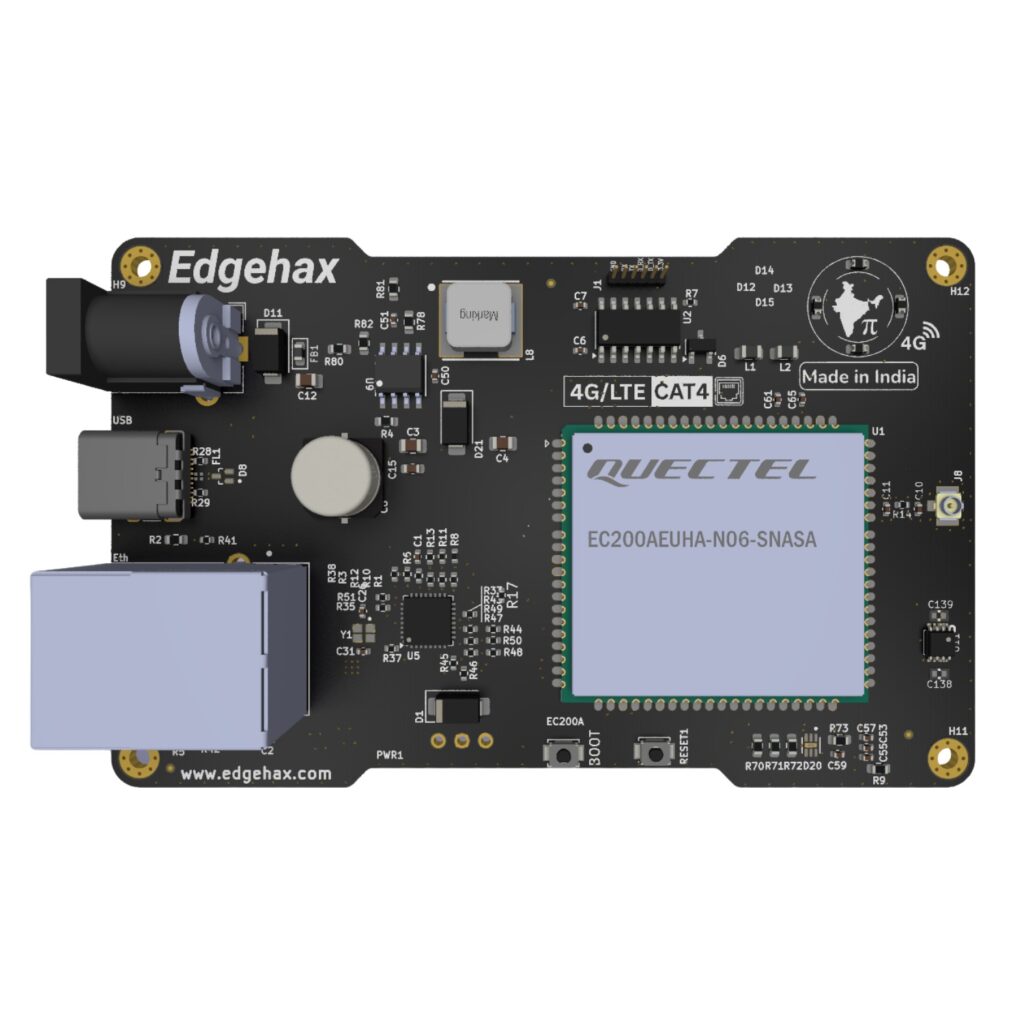
Edgehax 4G-CAT4 is a compact, rugged cellular connectivity board designed around the Quectel EC200A LTE Cat 4 module. The board measures 91 mm by 57 mm and is built on a 4-layer PCB that ensures good signal integrity, controlled impedance routing for RF and high-speed paths, and stable thermal performance. The design is intended for industrial and IoT deployments where reliability, wide temperature support, and stable power characteristics are essential.
At the heart of the design is a single EC200A module. This module supports LTE Cat 4 data rates of upto 150Mbps, built-in TCP/IP stack, USB high-speed data communication, multiple UARTs, I2C, SPI, PCM interfaces, and optional GNSS variants depending on the model. The EC200A is rated for industrial temperature ranges, typically operating from –40°C to +85°C, allowing the board to function reliably in demanding field conditions.
Key Interfaces
The Edgehax 4G-CAT4 exposes several communication interfaces for host processors and external peripherals. A USB Type-C connector provides USB 2.0 high-speed capabilities for data, AT command control, and firmware upgrades. The RMII Ethernet interface is routed out for users who wish to connect an external Ethernet PHY, which is particularly useful for building gateway-type products that require both LTE and wired LAN access. The board also includes multiple UARTs: a main AT command UART, a dedicated debug UART for low-level diagnostics, and an auxiliary UART for interfacing with microcontrollers, SBCs, or other external logic.
An I2C connector is available on the back side of the board for sensor expansion or integration with auxiliary ICs. Depending on the final firmware and application, several general-purpose GPIOs from the EC200A are also exposed to the user. These can be used for wake signals, trigger inputs, or simple control lines. The GPIOs operate at 1.8 V logic levels as per the module’s native design. In some board configurations, additional level shifting may be used to support 3.3 V interfacing, but the core logic remains 1.8 V. Typical drive strengths for the GPIOs are in the range of a few milliamps, suitable for digital control tasks.
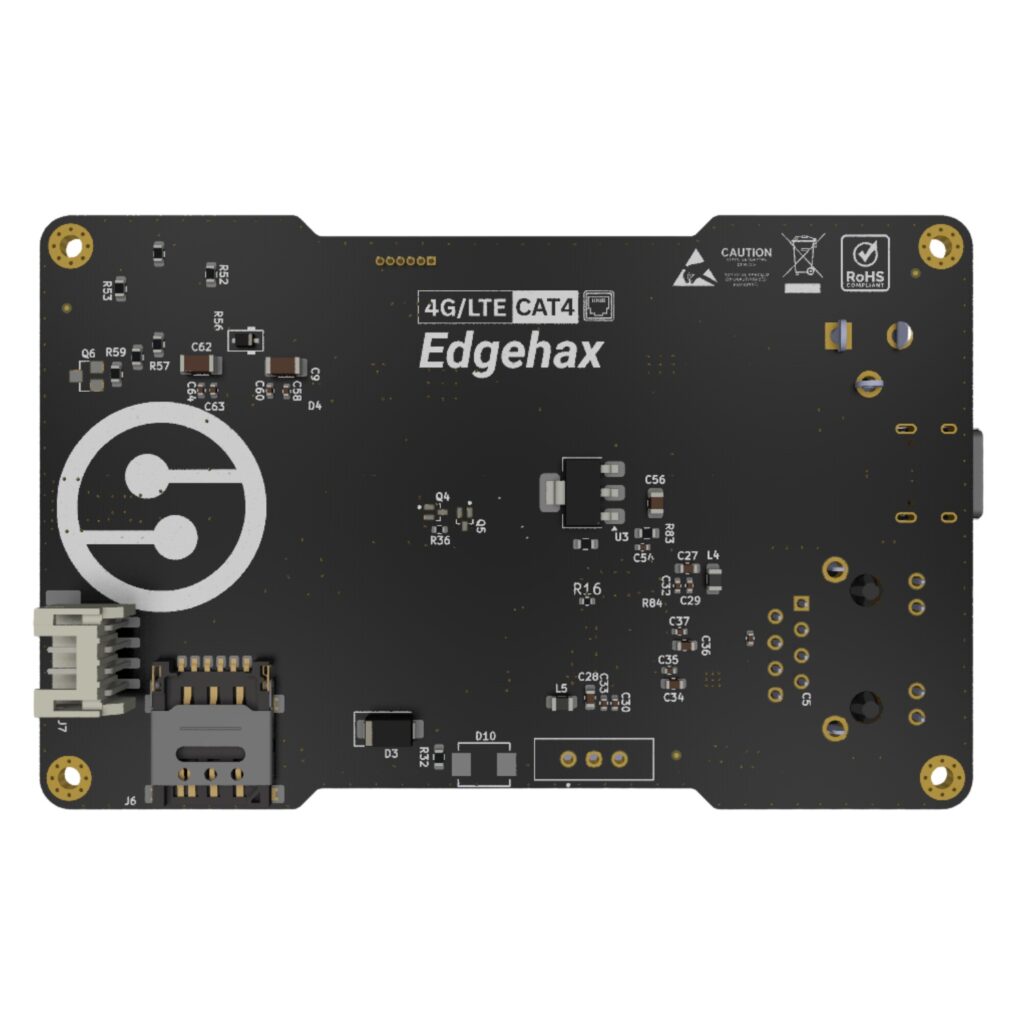
For cellular connectivity, the board includes a nano-SIM slot on the rare side. An U.FL antenna connector on the top side helps for the primary antenna connection. Depending on the chosen variant, support for antenna diversity may also be available. The U.FL is being considered to support easy enclosure mount with an SMA adapter. The RF section is routed carefully with short traces, ground shielding, and impedance-controlled paths following Quectel’s hardware guidelines.
4G Module SIMCOM A7672S LTE Cat-1 with ESP32 WROOM (Without GNSS). SimCom A7672S Chip supporting 4G/LTE with fall back to 2G, ESP32 onboard having WiFi and Bluetooth on a single board to build any IoT use case for students, developers, startups and innovators.
Power Requirements
Power input is designed for flexibility. The board accepts a wide input range of 5 to 12 volts at up to 2 amps through a DC jack. A high-efficiency DC-DC converter generates the main 4.0 V rail required by the EC200A module. Additional low-noise LDOs handle the regulated voltages needed for logic and auxiliary functions, including 1.8 V and 2.8 V rails. The power architecture is capable of handling the transient current peaks typical of LTE transmissions.
Build Quality
The PCB stackup and mechanical layout contribute to the ruggedness of the Edgehax 4G-CAT4. The use of a 4-layer design with dedicated ground and power planes ensures stable electrical performance, while the placement of connectors and mounting holes supports deployment in vibration-prone or outdoor enclosures. High-temperature FR-4 material is used to improve durability in industrial environments.
Conclusion
Overall, the Edgehax 4G-CAT4 provides a solid hardware foundation for building industrial gateways, remote monitoring units, IoT nodes, and edge-processing systems which require high bandwidth transmission. It offers a careful balance of connectivity, interface availability, and electrical robustness that makes it suitable for long-term field installations.